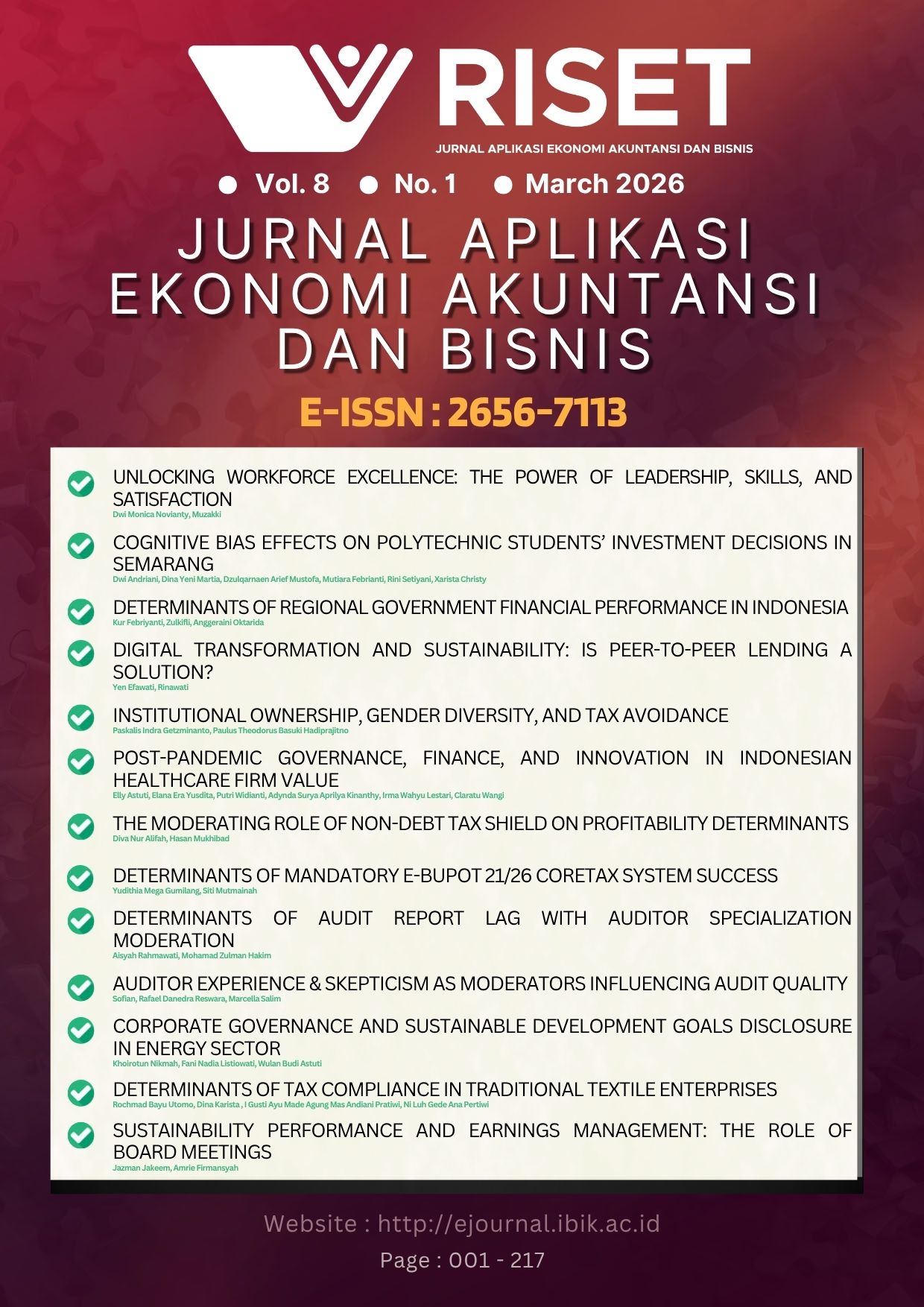
INSTITUTIONAL OWNERSHIP, GENDER DIVERSITY, AND TAX AVOIDANCE
DOI:
https://doi.org/10.37641/riset.v8i1.2824Keywords:
Institutional Ownership, Gender Diversity on Boards, Tax Avoidance, Mining Sector, Blau IndexAbstract
This research investigates how institutional ownership influences tax avoidance among Indonesian mining firms and further evaluates the moderating role of board gender diversity in this relationship. Tax avoidance is proxied by the Effective Tax Rate (ETR). The sample consists of 125 firm-year observations of mining companies listed on the Indonesia Stock Exchange during the 2022-2024 period. The hypotheses are tested using panel regression techniques, where the Random Effects specification is selected following a series of model selection procedures. Firm size, leverage, and profitability are included as control variables to isolate the governance effect from firm-specific characteristics that may influence tax avoidance. The results indicate that institutional ownership has a significant positive effect on ETR, suggesting that higher institutional ownership is associated with lower tax avoidance and stronger tax compliance. However, board gender diversity, measured using the Blau Index, does not significantly moderate the relationship between institutional ownership and tax avoidance. These findings contribute to agency theory by reinforcing the monitoring role of institutional investors in constraining managerial opportunism in tax-related decisions. Practically, the results highlight the importance of strengthening institutional ownership structures and enhancing governance transparency to promote sustainable tax compliance in capital-intensive industries.
Downloads
References
Aristyatama, H. A., & Riyadi, A. (2023). Level of Tax Avoidance Intersector: Case Study of Companies Listed on the Indonesia Stock Exchange. International Journal of Social Science And Human Research, 6(2), 1073–1083. https://doi.org/10.47191/ijsshr/v6-i2-40
Bird, A., & Karolyi, S. A. (2017). Governance and Taxes: Evidence from Regression Discontinuity. The Accounting Review, 92(1), 29–50. https://doi.org/10.2308/accr-51520
Bradshaw, M., Liao, G., & Ma, M. (Shuai). (2019). Agency Costs and Tax Planning When The Government is A Major Shareholder. Journal of Accounting and Economics, 67(2–3), 255–277. https://doi.org/10.1016/j.jacceco.2018.10.002
Budiana, E., & Kusuma, H. (2022). The Relationship between Gender Diversity and Tax Avoidance Practices. Research in Business & Social Science, 11(8), 241–250.
Chyz, J. A., Eulerich, M., Fligge, B., & Romney, M. A. (2023). Codetermination and Aggressive Reporting: Audit Committee Employee Representation, Tax Aggressiveness, and Earnings Management. Journal of International Accounting, Auditing and Taxation, 51, 100543. https://doi.org/10.1016/j.intaccaudtax.2023.100543
Dang, V. C., & Nguyen, Q. K. (2022). Audit Committee Characteristics and Tax Avoidance : Evidence from An Emerging Economy. Cogent Economics & Finance, 10(1), 1–15. https://doi.org/10.1080/23322039.2021.2023263
Drobetz, W., Ghoul, S. El, Guedhami, O., & Yu, X. (2025). Beyond Ownership: The Role of Institutional Investors in International Corporate Governance. Corporate Governance: An International Review, 22, 1024–1038. https://doi.org/10.1111/corg.12635
Dyreng, S. D., Hanlon, M., Maydew, E. L., & Thornock, J. R. (2017). Changes in Corporate Effective Tax Rates Over The Past 25 Years. Journal of Financial Economics, 124(3), 441–263. https://doi.org/10.1016/j.jfineco.2017.04.001
Giannopoulos, V., Vlachakou, M., Kariofyllas, S., & Makris, I. (2025). Corporate Governance and Tax Avoidance: Evidence from Greek Service-Sector Firms. Journal of Risk and Financial Management, 18(10), 1–34. https://doi.org/10.3390/jrfm18100538
Hambrick, D. C., & Mason, P. A. (1984). Upper Echelons: The Organization as A Reflection of Its Top Managers. The Academy of Management Review, 9(2), 193–206. https://doi.org/10.2307/258434
Hanlon, M., & Heitzman, S. (2010). A Review of Tax Research. Journal of Accounting and Economics, 50(2–3), 127–178. https://doi.org/10.1016/j.jacceco.2010.09.002
Kerr, J. N., Price, R., Román, F. J., & Romney, M. A. (2024). Corporate Governance and Tax Avoidance: Evidence from Governance Reform. Journal of Accounting and Public Policy, 47, 107232. https://doi.org/10.1016/j.jaccpubpol.2024.107232
Khan, M., Srinivasan, S., & Tan, L. (2017). Institutional Ownership and Corporate Tax Avoidance: New Evidence. The Accounting Review, 92(2), 101–122. https://doi.org/10.2308/accr-51529
Kyaw, K., Olugbode, M., & Petracci, B. (2017). Can Board Gender Diversity Promote Corporate Social Performance? Corporate Governance, 17(5), 789–802. https://doi.org/10.1108/CG-09-2016-0183
Laili, T. F., & Tjaraka, H. (2024). Gender Diversity in Leadership: Its Impact on Transfer Pricing and TAx Avoidance in Multinational Companies. Jurnal Akademi Akuntansi, 7(3), 468–479. https://doi.org/10.22219/jaa.v7i3.34785
Mouakhar, K., Kachouri, M., Riguen, R., & Jarboui, A. (2021). The Effect of Sustainability Performance and CSR on Corporate Tax Avoidance with Board Gender Diversity as Mediating Variable. Recherches En Sciences de Gestion 2020/3 N° 138, 303–339. https://doi.org/10.3917/resg.138.0303
Pontoh, J. F., & Kustinah, S. (2024). Political Connections, Board Gender Diversity, and Institutional Ownership on Tax Avoidance. Jurnal Akuntansi, 16(2), 264–278.
Sitompul, I. F., Anggraini, A. N. A., Lestari, I. H. S., & Brahmantara, N. (2024). Mapping Tax Avoidance Patterns of Public Companies in Indonesia Using The K-Means Clustering Method. Integrative Perspectives of Social and Science Journal (IPSSJ), 2(3), 6255–6271.
Sofianty, D., Murwaningsari, E., & Mulyani, S. D. (2022). Gender Diversity Effect on Tax Avoidance and Firm Risk. Technium Social Sciences Journal, 27, 463–480.
Sulistiyanti, U., & Saputra, A. D. (2020). Determinants of Tax Avoidance : Evidence from Indonesian Mining Industry. Journal of Contemporary Accounting, 2(3), 165–174. https://doi.org/10.20885/jca.vol2.iss3.art5
Susilawati, E., & Tarmidi, D. (2024). The Influence of Institutional Ownership and Foreign Ownership on Tax Avoidance with Audit Quality as A Moderation Variable. Asian Journal of Economics, Business and Accounting, 24(5), 1–11. https://doi.org/10.9734/AJEBA/2024/v24i51286
Tamimi, A. H. at, & Firmansyah, A. (2024). Women at The Wheel, Less Tax at The Deal? Moderating Tax Avoidance: The Role of Public Ownership. Indonesian Tax Review, 8(1), 72–89. https://doi.org/10.31092/jpi.v8i1.2789
Downloads
Published
How to Cite
Issue
Section
License
Copyright (c) 2026 RISET: Jurnal Aplikasi Ekonomi Akuntansi dan Bisnis

This work is licensed under a Creative Commons Attribution-NonCommercial-ShareAlike 4.0 International License.




.png)
.png)
.png)




.png)