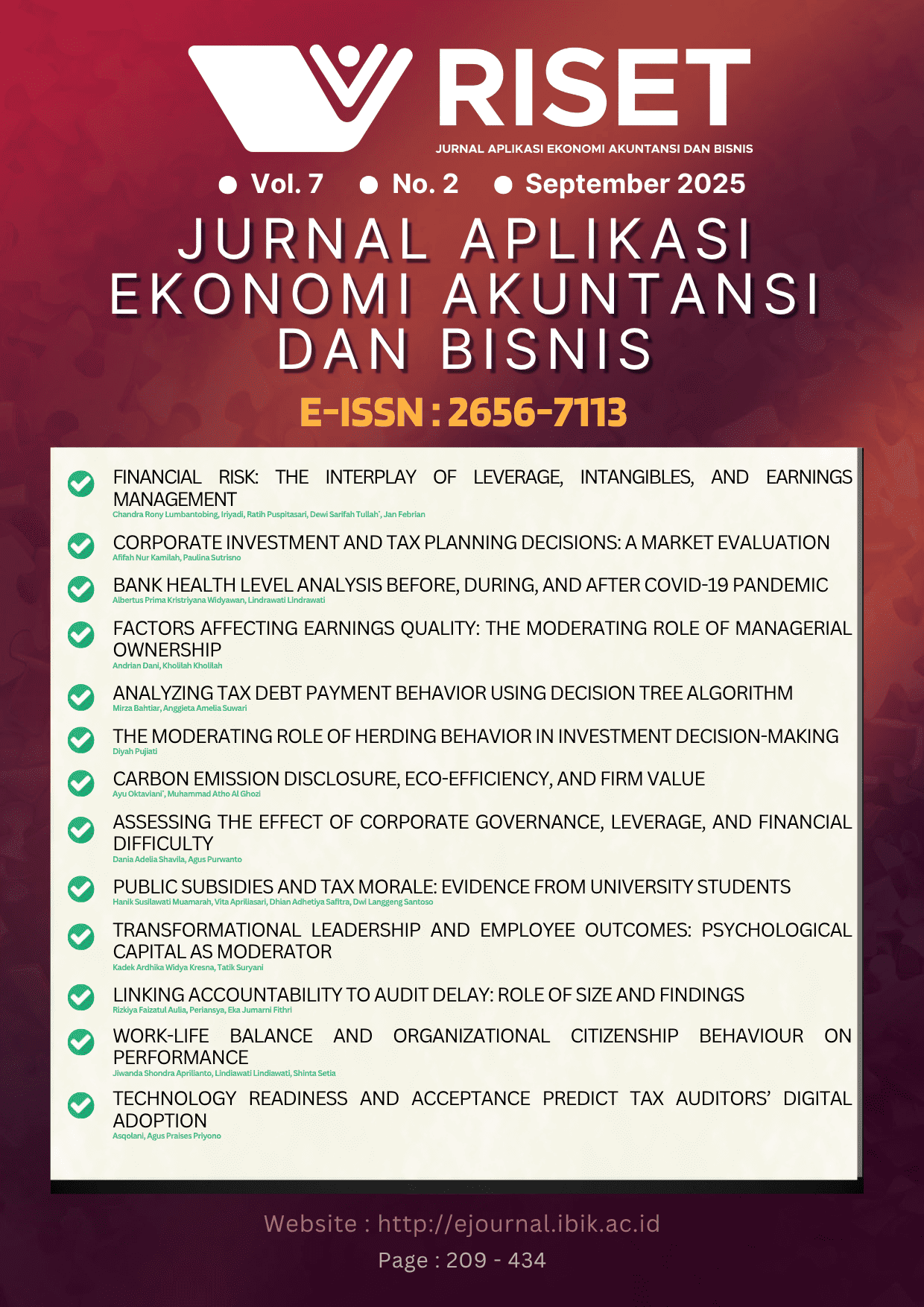
FINANCIAL RISK: THE INTERPLAY OF LEVERAGE, INTANGIBLES, AND EARNINGS MANAGEMENT
DOI:
https://doi.org/10.37641/riset.v7i2.2623Keywords:
Leverage, Intangible Assets, Financial Risk Tolerance, Earnings Management, Financial DistressAbstract
Manufacturing companies face financial risks that may lead to financial distress, primarily due to high leverage and the uncertainty of intangible asset values. This study uses earnings management as a moderating variable to investigate how leverage and intangible assets affect financial risk. Using a purposive sample technique, the study uses secondary data from the 2019–2023 financial statements of industrial businesses registered on the Indonesia Stock Exchange (IDX). Data analysis is conducted through panel data regression, employing the Zmijewski model to measure financial risk. The findings reveal that leverage positively affects financial risk, supporting agency theory, which suggests that high debt levels increase financial pressure on firms.
In contrast, intangible assets do not significantly influence financial risk. Earnings management reduces financial risk and weakens the impact of leverage, but does not significantly moderate the relationship between intangible assets and financial risk. The study concludes that companies must manage and leverage prudently and optimize using intangible assets to mitigate financial risk. From a practical perspective, investors and creditors should consider earnings management practices when assessing a company's risk profile.
Downloads
References
Agustia, D., Asyik, N. F., & Midiantari, N. (2021). Intellectual Capital on Financial Performance and Sustainable Growth. EKUITAS (Jurnal Ekonomi Dan Keuangan), 5(2), 159–179. https://doi.org/10.24034/j25485024.y2021.v5.i2.4744
Agustia, D., Muhammad, N. P. A., & Permatasari, Y. (2020). Earnings Management, Business Strategy, and Bankruptcy Risk: Evidence from Indonesia. Heliyon, 6(2), 1–9. https://doi.org/10.1016/j.heliyon.2020.e03317
Albert, M. G., & Maudos, J. (2022). The Importance of Intangible Assets in Regional Economic Growth: A Growth Accounting Approach. The Annals of Regional Science, 69(2), 361–390. https://doi.org/10.1007/s00168-022-01138-6
Ali, J., Tahira, Y., Amir, M., Ullah, F., Tahir, M., Shah, W., Khan, I., & Tariq, S. (2022). Leverage, Ownership Structure and Firm Performance. Journal of Financial Risk Management, 11(1), 41–65. https://doi.org/10.4236/jfrm.2022.111002
Almubarak, W. I., Chebbi, K., & Ammer, M. A. (2023). Unveiling The Connection among ESG, Earnings Management, and Financial Distress: Insights from an Emerging Market. Sustainability, 15(16), 1–23. https://doi.org/10.3390/su151612348
Ambarwati, K. F., & Sriwardany. (2022). Comparative Analysis of The Springate Model and The Zmijewski Model in Measuring Corporate Health Level at PT. Bintang Persada Satelit. Indonesian Journal of Business Analytics, 1(2), 261–270. https://doi.org/10.55927/ijba.v1i2.30
Apsari, C. M., Pristiana, U., & Brahmayanti, I. A. S. (2024). Comparative Accuracy Analysis of Altman Z-Score, Springate, and Zmijewski Models for Predicting Financial Distress in Cigarette Sector Companies. Indonesian Journal of Innovation Multidisipliner Research, 2(3), 200–211. https://doi.org/10.69693/ijim.v2i3.171
Barker, R., Lennard, A., Penman, S., & Teixeira, A. (2022). Accounting for Intangible Assets: Suggested Solutions. Accounting and Business Research, 52(6), 601–630. https://doi.org/10.1080/00014788.2021.1938963
Brunnermeier, M., & Krishnamurthy, A. (2020). Corporate Debt Overhang and Credit Policy (Brookings Papers on Economic Activity). https://www.brookings.edu/articles/corporate-debt-overhang-and-credit-policy/
Chu, Y. (2016). Shareholder-Creditor Conflict and Payout Policy: Evidence from Mergers between Lenders and Shareholders (Forthcoming, Review of Financial Studies). https://doi.org/10.2139/ssrn.2726315
Desiyanti, O., Soedarmo, W., Chandra, K., & Kusnadi, K. (2019). The Effect of Financial Ratios to Financial Distress Using Altman Z-Score Method in Real Estate Companies Listed in Indonesia Stock Exchange Period 2014 - 2018. Business and Entrepreneurial Review, 19(2), 119–136. https://doi.org/10.25105/ber.v19i2.5699
Dirman, A. (2020). Financial Distress: The Impact of Profitability, Liquidity, Leverage, Firm Size, and Free Cash Flow. International Journal of Business, Economics and Law, 22(1), 17–25. https://ijbel.com/wp-content/uploads/2020/08/IJBEL22_205.pdf
Durana, P., Michalkova, L., Privara, A., Marousek, J., & Tumpach, M. (2021). Does The Life Cycle Affect Earnings Management and Bankruptcy? Oeconomia Copernicana, 12(2), 425–461. https://doi.org/10.24136/oc.2021.015
Farooq, M., Noor, A., Qureshi, S. F., & Bhutta, Z. M. (2021). Indirect Financial Distress Costs in Non-Financial Firms: Evidence from an Emerging Market. Pacific Accounting Review, 33(4), 417–434. https://doi.org/10.1108/PAR-09-2020-0127
Fauziah, S. N., & Herawaty, V. (2023). The Influence of Business Strategy, Market Effect, and Profit Management on Bankruptcy Risk During The COVID-19 Pandemic as Moderating Variables. Jurnal Ekonomi Trisakti, 3(1), 1209–1218. https://doi.org/10.25105/jet.v3i1.16070
Febriana, A. M., & Triyono, T. (2024). The Influence of Capital Structure, Tangible Assets, Intangible Assets, and Sales Growth on Company Value with Financial Performance as an Intervening Variable (Empirical Study on Properties and Real Estate Companies Listed on The Indonesian Stock Exchang. Media Mahardhika, 22(3), 503–521. https://doi.org/10.29062/mahardika.v22i3.947
Gamayuni, R. R. (2015). The Effect Of Intangible Asset, Financial Performance And Financial Policies On The Firm Value. International Journal of Scientific & Technology Research, 4(1), 202–212. http://repository.lppm.unila.ac.id/1439/1/The-Effect-Of-Intangible-Asset-Financial-Performance-And-Financial-Policies-On-The-Firm-Value.pdf
Gunarathna, V. (2015). How Does Financial Leverage Affect Financial Risk? An Empirical Study in Sri Lanka. https://papers.ssrn.com/sol3/papers.cfm?abstract_id=3447293
Habib, A., Costa, M. D’, Huang, H. J., Bhuiyan, M. B. U., & Sun, L. (2020). Determinants and Consequences of Financial Distress: Review of The Empirical Literature. Accounting & Finance, 60(S1), 1023–1075. https://doi.org/10.1111/acfi.12400
Kurnia, B., & Mulyati, Y. (2023). The Effect of Free Cash Flow and Financial Distress on Earnings Management in Infrastructure, Utilities, and Transportation Companies Listed on The Indonesia Stock Exchange. Owner, 7(2), 1596–1611. https://doi.org/10.33395/owner.v7i2.1395
Lavopa, A., & Donnelly, C. (2023). Socioeconomic Resilience During The COVID-19 Pandemic. The Role of Industrial Capabilities. Structural Change and Economic Dynamics, 67, 44–57. https://doi.org/10.1016/j.strueco.2023.06.004
Liu, Y., Cheng, P., OuYang, Z., & Wang, A. (2019). Information Asymmetry and Investor Valuations of Initial Public Offerings: Two Dimensions of Organizational Reputation as Stock Market Signals. Management and Organization Review, 16(4). https://www.cambridge.org/core/journals/management-and-organization-review/article/abs/information-asymmetry-and-investor-valuations-of-initial-public-offerings-two-dimensions-of-organizational-reputation-as-stock-market-signals/E40E10EF2D1A8649BDE7FAE85D01DB09
Lubis, N. W. (2022). Resource Based View (RBV) in Improving Company Strategic Capacity. Research Horizon, 2(6), 587–596. https://doi.org/10.54518/rh.2.6.2022.587-596
Lugina, E. J., Mwakalobo, A. B. S., & Lwesya, F. (2022). Effects of Industrialization on Tanzania’s Economic Growth: A Case of Manufacturing Sector. Future Business Journal, 8(62), 1–11. https://doi.org/10.1186/s43093-022-00177-x
Meryana, & Setiany, E. (2021). The Effect of Investment, Free Cash Flow, Earnings Management, and Interest Coverage Ratio on Financial Distress. Journal of Social Science, 2(1), 64–69. https://doi.org/10.46799/jss.v2i1.86
Napiajo, Beananda, S. R., & Serini, A. (2023). Profit Management in Mining Companies Listed on The Indonesia Stock Exchange in the 2020-2022 Period Through Profitability, Leverage, and Company Size. Jurnal Ekonomi STIEP, 8(2), 88–95. https://doi.org/10.54526/jes.v8i2.199
Nasir, M. J. A. (2021). The Effect of Leverage, Sales Growth, and Company Size on Profitability. Buletin Ekonomi: Manajemen, Ekonomi Pembangunan, Akuntansi, 18(2), 261–286. https://doi.org/10.31315/be.v18i2.5642
Nerotumilena, T., & Winarna, J. (2024). Altman Z-Score and Zmijewski X-Score Models on Performance to Assess the Bankruptcy Risk of Mining Companies on IDX Indonesia 2018-2022. JBTI : Jurnal Bisnis : Teori Dan Implementasi, 15(3), 273–287. https://doi.org/10.18196/jbti.v15i3.24281
Nguyen, T. T., & Kien, V. D. (2022). Leverage and Bankruptcy Risk - Evidence from Maturity Structure of Debt: An Empirical Study from Vietnam. The Journal of Asian Finance, Economics and Business, 9(1), 133–142. https://koreascience.kr/article/JAKO202200567727471.page
Nini, N., Patrisia, D., & Nurofik, A. (2020). The Effect of Capital Structure on Company Financial Performance. Jurnal Economia, 16(2), 173–183. https://doi.org/10.21831/economia.v16i2.30661
Onsongo, S. K., Muathe, S. M. A., & Mwangi, L. W. (2020). Financial Risk and Financial Performance: Evidence and Insights from Commercial and Services Listed Companies in Nairobi Securities Exchange, Kenya. International Journal of Financial Studies, 8(51), 1–15. https://doi.org/10.3390/ijfs8030051
Pangi, W. B., & Dewi, R. (2023). The Influence of Human Capital, Intangible Assets, Diversification, and Information Technology Investment on Financial Distress in The Covid-19 Situation. Jurnal Informatika Ekonomi Bisnis, 5(1), 103–110. https://doi.org/10.37034/infeb.v5i1.195
Pradana, R. W., & Chalid, D. A. (2023). Intellectual Capital and Firm’s Financial Distress Risk: Evidence from Developed and Developing Countries. Journal of Theory and Applied Management, 16(2), 309–320. https://doi.org/10.20473/jmtt.v16i2.45672
Prakoso, N. A., Harahap, M. N., & Nasution, R. (2024). Effect of Current Ratio, Debt-to-Equity Ratio, Return on Assets, and Company Size on The Risk of Business Failure (Empirical Study of Food and Beverage Companies Listed on The Indonesia Stock Exchange in 2019-2021). Jurnal Ilmiah Wahana Pendidikan, 10(3), 552–268. https://jurnal.peneliti.net/index.php/JIWP/article/view/6145
Prasetya, G., & Muid, D. (2022). The Effect of Profitability and Leverage on Tax Avoidance. Diponegoro Journal of Accounting, 11(1), 1–6. https://ejournal3.undip.ac.id/index.php/accounting/article/view/32960/26325
Putra, A. S., & Satria, H. (2022). Accounting Conservatism: Financial Distress and Debt to Equity Ratio. Jurnal Ilmiah Akuntansi Dan Finansial Indonesia, 6(1), 1–12. https://doi.org/10.31629/jiafi.v6i1.4644
Putri, D. M. A., Cantika, S. T., Ningtyas, R. C., & Leon, F. M. (2021). Determining Factors in The Indirect Financial Distress Cost in Companies in The Basic and Chemical Industry Sector Listed on The Indonesia Stock Exchange. International Journal of Innovative Science and ResearchTechnology, 6(12), 1051–1058. https://www.ijisrt.com/assets/upload/files/IJISRT21DEC630_(1).pdf
Putri, Z. A., Eca, E., Putriani, H., Fiana, F., & Fadillah, B. (2024). Financial Transparency and Corporate Performance: Uncovering The Relationship Between Earnings Management and Corporate Value. Prosiding Seminar Teknologi, Akuntansi, Bisnis, Ekonomi, Dan Komunitas, 4.
Rachmawati, Y., & Sulbahri, R. A. (2020). Comparative Analysis of The Springate and Zmijewski Models in Predicting Bankruptcy in Food and Beverage Companies Listed on The Indonesian Stock Exchange in 2018. Jurnal Keuangan Dan Bisnis, 18(1), 147–158. https://doi.org/10.32524/jkb.v18i1.660
Rahma, N. H., & Dillak, V. J. (2021). The Influence of Capital Structure, Company Size, Sales Growth and Intangible Assets on Financial Distress. Jurnal Ilmiah Manajemen, Ekonomi, & Akuntansi (MEA), 5(3), 378–395. https://journal.stiemb.ac.id/index.php/mea/article/view/1480
Rahman, M. M., Saima, F. N., & Jahan, K. (2020). The Impact of Financial Leverage on Firm’s Profitability: An Empirical Evidence from Listed Textile Firms of Bangladesh. Journal of Business Economics and Environmental Studies, 10(2), 23–31. https://doi.org/10.13106/jbees.2020.vol10.no2.23
Rahmani, H. F. (2022). Drivers of Earnings Management in Terms of Company Size and Financial Distress. Jurnal Ekonomi Bisnis, Manajemen Dan Akuntansi (JEBMA), 2(2), 55–59. https://doi.org/10.47709/jebma.v2i2.1832
Revo. (2024, September 12). Indonesian Manufacturing Industry in Shattered: Many Companies Go Bankrupt, Layoffs Flood. CNBC Indonesia. https://www.cnbcindonesia.com/research/20240912122027-128-571301/manufaktur-ri-hancur-lebur-perusahaan-banyak-bangkrut-banjir-phk
Riyani, B. S. L., & Putra, R. J. (2024). The Influence of Intangible Assets and Research Activities on Company Performance and Their Impact on Stock Price Movements: A Study of Manufacturing Companies Listed on The IDX. Al-Kharaj: Jurnal Ekonomi, Keuangan & Bisnis Syariah, 6(8), 5992–6005. https://doi.org/10.47467/alkharaj.v6i8.4341
Sari, M., & Diana, H. (2020). Financial Ratio Analysis to Predict Financial Distress Conditions of Pulp and Paper Companies Listed on The Indonesia Stock Exchange in 2012-2017 with The Altman Z-Score Model. Research in Accounting Journal, 1(1), 32–48. https://journal.yrpipku.com/index.php/raj/article/view/32/19
Sayidah, N., Assagaf, A., & Faiz, Z. (2020). Does Earning Management Affect Financial Distress? Evidence from State-Owned Enterprises in Indonesia. Cogent Business & Management, 7(1832826), 1–14. https://doi.org/10.1080/23311975.2020.1832826
Schwartz, A., Yavorsky, N. D., & Osborn, M. (2024). Trends in Large Corporate Bankruptcy and Financial Distress. https://www.cornerstone.com/insights/reports/trends-in-large-corporate-bankruptcy-and-financial-distress/
Scott, W. R., & O’Brien, Pa. C. (2020). Financial Accounting Theory (8th ed.). Pearson. https://digilib.perbanas.id/index.php?p=show_detail&id=1127991&keywords=
Seprianti, D., Lestari, F. R., Putri, G. F., Yuni, G. P. D., & Leli, I. (2023). Analysis of Intangible Assets in The Tanah Datar District Health Office. Al Dzahab, 4(2), 133–142. https://doi.org/10.32939/dhb.v4i2.2791
Setyoningrum, R., Wardoyo, D. U., Amin, A. S., & Sabilla, R. (2022). The Effect of Intangible Assets and Liquidity on Financial Distress (in Industrial Sector Companies Listed on The Indonesia Stock Exchange in 2018-2020). Jurnal Publikasi Ekonomi Dan Akuntansi, 2(2), 172–186. https://doi.org/10.51903/jupea.v2i2.327
Sihotang, L. Y., & Muliyani. (2024). The Influence of Intangible Assets, Sales Growth, and Operating Cash Flow on Financial Distress. Musytari : Neraca Manajemen, Akuntansi, Dan Ekonomi, 7(3), 1–14. https://ejournal.warunayama.org/index.php/musytarineraca/article/view/4924
Soetardjo, M. N., & Wijaya, M. A. (2024). The Effect of Tax Burden, Intangible Assets and Audit Quality on Transfer Pricing Decisions. Klabat Accounting Review, 5(1), 24–46. https://doi.org/10.60090/kar.v5i1.1049.24-46
Sunartoputra, D., Atma, P., & Fathurrachman, G. (2023). The Indonesian Insolvency and Restructuring Landscape. PWC Indonesia. https://www.pwc.com/id/en/pwc-publications/services-publications/legal-publications/the-indonesian-insolvency-and-restructuring-landscape.html
Susanti, N., Latifa, I., & Sunarsi, D. (2020). The Effects of Profitability, Leverage, and Liquidity on Financial Distress on Retail Companies Listed on Indonesian Stock Exchange. Jurnal Ilmiah Ilmu Administrasi Publik, 10(1), 45–52. https://doi.org/10.26858/jiap.v10i1.13568
Thamlim, W., & Mulyani, S. D. (2023). The Impact of Information Asymmetry, ESOP, and Audit Quality on Earnings Management with Financial Difficulties as a Moderating Variable. Media Riset Akuntansi, Auditing & Informasi, 23(2), 353–374. https://doi.org/10.25105/mraai.v23i2.17187
Tutliha, Y. S., & Rahayu, M. (2019). The Influence of Intangible Assets, Operating Cash Flow and Leverage on Financial Distress. IKRA-ITH EKONOMIKA, 2(1), 95–103. https://journals.upi-yai.ac.id/index.php/IKRAITH-EKONOMIKA/article/view/425
United Nations Industrial Development Organization. (2020). Impact Assessment of Covid-19 on Indonesia’s Manufacturing Firms. https://www.unido.org/sites/default/files/unido-publications/2023-02/impact-assessment-of-covid-19-on-indonesias-manufacturing-firms-en.pdf
Widanastiti, S. A., & Rahayu, P. (2020). The Influence of Capital Structure, Asset Structure and Ownership Structure on Financial Risk in Property and Real Estate Companies Listed on The Indonesian Stock Exchange in The 2015-2017 Period. JCA (Jurnal Cendekia Akuntansi), 1(1), 9–17. https://doi.org/10.32503/akuntansi.v1i1.1061
Yudha, A. Z., Abustam, A., & Tenrigau, A. P. (2025). Revealing Bankruptcy Prediction: Accuracy Comparison of Altman, Springate, and Zmijewski Models on PT Garuda Indonesia. Journal of Economic and Social Science (JoESS), 2(1), 181–186. https://andipandangaijournal.com/index.php/JoESS/article/view/35/43
Zelalem, B. A., & Abebe, A. A. (2022). Does Intangible Assets Affect The Financial Performance and Policy of Commercial Banks’ in The Emerging Market? PLOS ONE, 17(8), e0272018. https://doi.org/10.1371/journal.pone.0272018
Zhu, L., Li, M., & Metawa, N. (2021). Financial Risk Evaluation Z-Score Model for Intelligent IoT-based Enterprises. Information Processing & Management, 58(6), 102692. https://doi.org/10.1016/j.ipm.2021.102692
Zolotoy, L., O’Sullivan, D., Martin, G. P., & Wiseman, R. M. (2021). Stakeholder Agency Relationships: CEO Stock Options and Corporate Tax Avoidance. Journal of Management Studies, 58(3), 782–814. https://doi.org/10.1111/joms.12623
Downloads
Published
How to Cite
Issue
Section
License
Copyright (c) 2025 RISET: Jurnal Aplikasi Ekonomi Akuntansi dan Bisnis

This work is licensed under a Creative Commons Attribution-NonCommercial-ShareAlike 4.0 International License.




.png)
.png)
.png)




.png)